Payment

Integrating Payment Solutions into Your Mobile App

As you develop your mobile app, you’ll need to consider how users will make payments. You want to provide a seamless and secure experience, and integrating payment solutions is key. Your goal is to make transactions easy and efficient, and with the right payment gateway, you can achieve this. You’ll need to evaluate various options and choose the one that best fits your app’s needs, considering factors such as security, fees, and user experience. By doing so, you can enhance your app’s functionality and increase user engagement.

Key Takeaways:

  • Seamless payment integration is imperative for a positive user experience, allowing users to make transactions quickly and efficiently within the app.
  • Supporting multiple payment methods, such as credit cards, PayPal, and mobile wallets, can increase user adoption and retention by catering to different user preferences.
  • Implementing robust security measures, such as encryption and two-factor authentication, is vital to protect user data and prevent fraudulent transactions.
  • Streamlining the payment process through features like one-touch payments and saved payment information can reduce friction and increase conversion rates.
  • Continuously monitoring and optimizing payment performance, including transaction success rates and user feedback, can help identify areas for improvement and inform future development decisions.

Payment Gateway Selection

Before integrating a payment solution into your mobile app, you need to select a payment gateway that meets your business needs. You should consider factors such as transaction fees, payment methods, and scalability.

Major Payment Providers

Gateways like Stripe, PayPal, and Square offer a range of payment solutions that you can integrate into your app, allowing your users to make seamless transactions.

Security Standards and Compliance

Against potential threats, you must ensure that your payment gateway adheres to strict security standards, such as PCI-DSS and GDPR, to protect your users’ sensitive information.

This is especially important as you handle sensitive user data, and any breach can damage your reputation and lead to financial losses. You should look for a payment gateway that has a proven track record of security and compliance, and provides you with the necessary tools and support to maintain the highest security standards in your app.

Technical Implementation

Any mobile app developer knows that integrating payment solutions requires careful consideration of technical details. You will need to choose the right payment gateway and ensure seamless integration with your app.

API Integration Steps

At this stage, you will need to follow specific API integration steps to connect your app with the payment gateway, allowing you to process transactions securely and efficiently, and you should test your integration thoroughly to ensure it works as expected.

SDK Configuration

Technically, configuring the SDK is a straightforward process that requires you to set up the necessary libraries and dependencies in your project, and you should consult the payment gateway’s documentation for specific instructions on how to do this.

Also, as you configure the SDK, you will need to handle errors and exceptions properly, and you should implement logging and debugging mechanisms to troubleshoot any issues that may arise during the payment process, ensuring a smooth user experience for your customers.

User Experience Design

Now that you’re integrating payment solutions into your mobile app, it’s crucial to consider the user experience. Your goal is to create a seamless and intuitive payment process that enhances your app’s overall usability.

Payment Flow Optimization

Enhancing the payment flow is vital to minimize friction and maximize conversions. You should aim to simplify the payment process, reducing the number of steps required to complete a transaction, making it easier for your users to make payments.

Interface Elements

Following the optimized payment flow, you’ll need to design interface elements that support it. You should focus on creating clear and concise labels, buttons, and typography that guide your users through the payment process.

Even when designing individual interface elements, you should consider how they contribute to the overall payment experience. You can use visual hierarchy, color, and whitespace to draw attention to key elements, such as the payment button or error messages, ensuring that your users can easily navigate the payment process and complete transactions successfully.

Security Measures

Once again, you will need to prioritize security when integrating payment solutions into your mobile app, as this will help protect your users’ sensitive information and maintain their trust in your brand.

Data Encryption Protocols

Besides other security measures, you should implement robust data encryption protocols to safeguard your users’ financial data, ensuring that all transactions are secure and protected from unauthorized access.

Fraud Prevention Systems

About the security of your mobile app, you should consider implementing fraud prevention systems that can detect and prevent suspicious activity, helping to minimize the risk of financial losses and reputational damage.

Measures such as machine learning algorithms and behavioral analysis can be used to identify potential fraud, allowing you to take proactive steps to prevent it and protect your users, thereby maintaining the integrity of your mobile app and the trust of your users.

Testing and Quality Assurance

Despite the complexity of payment solutions, you can ensure a seamless user experience by testing your mobile app. Check out A Guide to Payment Gateway Integration for Your Mobile App for more information.

Payment Scenario Testing

Among the various testing methods, you should prioritize payment scenario testing to ensure your app handles different payment scenarios correctly.

Performance Monitoring

Around the clock, your app’s performance can impact user experience, so you should monitor it regularly.

With performance monitoring, you can identify and fix issues before they affect your users, ensuring your app’s payment solutions function smoothly and efficiently, allowing you to provide a better experience for your users and increase their trust in your app.

Regulatory Compliance

Not adhering to regulatory requirements can lead to severe consequences, so you must ensure your payment solution complies with relevant laws and regulations.

Regional Payment Laws

Besides varying by country, regional payment laws also differ by industry, and you need to understand these differences to implement a compliant payment solution in your mobile app.

Data Protection Requirements

Paying attention to data protection is necessary, and you must implement robust security measures to safeguard your users’ sensitive information and maintain their trust in your app.

At the heart of data protection requirements is the need to ensure the confidentiality, integrity, and availability of your users’ data, and you can achieve this by implementing encryption, secure authentication, and access controls, which will help you to protect your users’ data and maintain a secure payment environment in your mobile app.

To wrap up

Presently, you have the knowledge to integrate payment solutions into your mobile app, enhancing your users’ experience. You can now provide a seamless and secure payment process, increasing conversions and customer satisfaction. By following best practices and considering your target audience, you can optimize your payment solutions to meet your business needs, ultimately driving growth and revenue for your mobile app.

FAQ

Q: What are the benefits of integrating payment solutions into my mobile app?

A: Integrating payment solutions into your mobile app provides a seamless and convenient user experience, allowing customers to make payments directly within the app. This can lead to increased conversions, reduced cart abandonment rates, and improved customer satisfaction. Additionally, payment solutions can provide a secure and reliable way to process transactions, reducing the risk of fraud and chargebacks. By integrating payment solutions, you can also access valuable transaction data and insights, helping you to optimize your app’s performance and improve your overall business strategy.

Q: How do I choose the right payment solution for my mobile app?

A: Choosing the right payment solution for your mobile app depends on several factors, including your target audience, transaction volume, and the types of payments you want to accept. You should consider the fees associated with each payment solution, as well as the level of security and compliance they offer. It’s also important to evaluate the user experience and ensure that the payment solution integrates seamlessly with your app. Some popular payment solutions for mobile apps include credit card payments, PayPal, and mobile wallets like Apple Pay and Google Pay. You may also want to consider emerging payment technologies, such as blockchain and cryptocurrency payments.

Q: What are the security considerations I need to keep in mind when integrating payment solutions into my mobile app?

A: When integrating payment solutions into your mobile app, security is a top priority. You need to ensure that sensitive payment information, such as credit card numbers and expiration dates, is protected from unauthorized access. This can be achieved through the use of secure protocols, such as HTTPS and TLS, as well as encryption and tokenization. You should also comply with industry standards, such as PCI-DSS, and implement robust authentication and authorization mechanisms to prevent fraudulent transactions. Additionally, you should regularly update and patch your app to prevent vulnerabilities and ensure that your payment solution is compliant with relevant regulations, such as GDPR and CCPA.

Innovative Payment Solutions Within Mobile Apps

As you navigate through your favorite mobile apps, you’re likely to encounter various payment options that make transactions seamless and efficient. Your experience is being shaped by innovative payment solutions that prioritize convenience and security. You can now make payments with a few taps, using methods such as in-app wallets, mobile payments, and more. This shift in payment technology is transforming the way you interact with mobile apps, and it’s necessary to understand the latest developments in this space to make the most of your mobile experience.

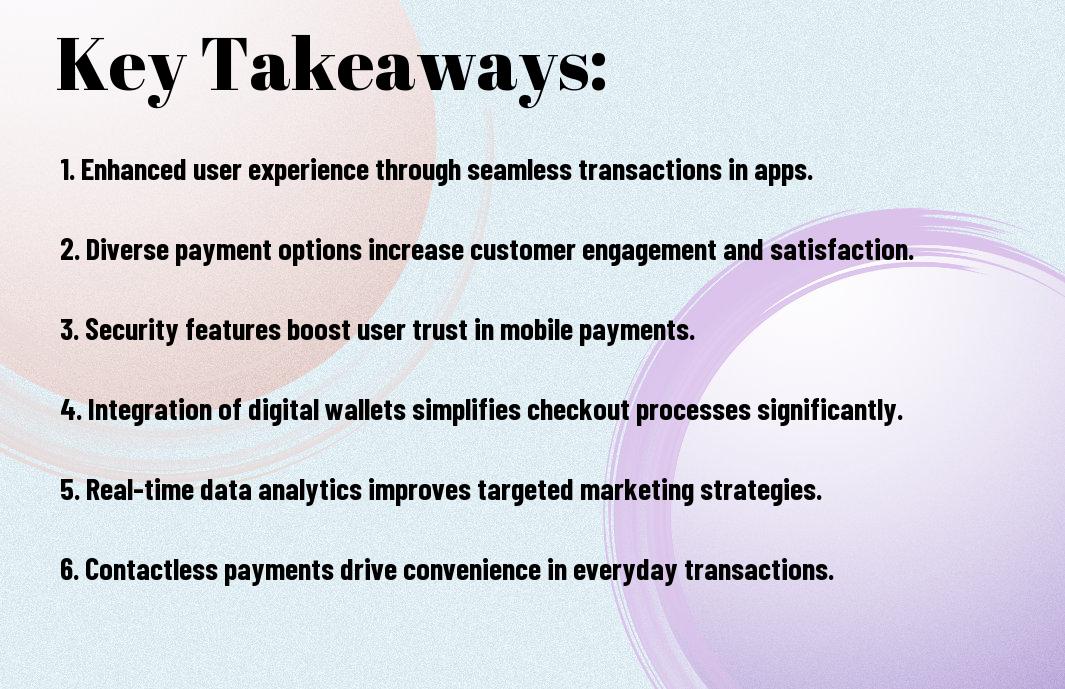
Key Takeaways:

  • Mobile apps are increasingly incorporating innovative payment solutions to enhance user experience, with features such as one-touch payments, biometric authentication, and tokenization for secure transactions.
  • Integration of digital wallets like Apple Pay, Google Pay, and PayPal into mobile apps provides users with a seamless and convenient payment experience, reducing friction and increasing conversion rates.
  • In-app payment solutions also enable businesses to offer personalized promotions, loyalty programs, and rewards, helping to build customer loyalty and drive engagement.
  • The use of blockchain technology and cryptocurrencies within mobile apps is becoming more prevalent, offering a secure and transparent way to conduct transactions and transfer value.
  • As mobile payments continue to grow in popularity, it’s vital for businesses to prioritize security and compliance, ensuring that their in-app payment solutions meet regulatory requirements and protect sensitive user data.

Evolution of Mobile Payments

For your understanding of innovative payment solutions, it’s crucial to learn about the evolution of mobile payments. You can find more information in A Comprehensive Guide to Mobile Payment Systems and Trends to stay updated on the latest developments.

Traditional Payment Methods

After using traditional payment methods for years, you’re likely familiar with their limitations. You can see how mobile payments have improved upon these methods, offering more convenience and security.

Digital Transformation

Digitally, your payment experiences are becoming more seamless and integrated. You can expect a more streamlined process with mobile payments, making transactions faster and more efficient.

The digital transformation of payment systems has led to significant advancements in mobile payments, allowing you to make transactions with just a few taps on your screen. You can now use your mobile device to pay for various services, from online shopping to in-store purchases, making your life more convenient and hassle-free.

Core Technologies

One of the key aspects of innovative payment solutions within mobile apps is the underlying technology that enables seamless transactions. You will find that technologies such as NFC, QR code integration, and tokenization play a significant role in facilitating secure and efficient payments.

Near Field Communication (NFC)

Between the various technologies used in mobile payments, NFC stands out for its ability to enable contactless transactions. You can use your mobile device to make payments by simply tapping it on an NFC-enabled terminal, making the payment process quick and convenient.

QR Code Integration

Fielding a wide range of payment options, QR code integration allows you to make payments by scanning a unique code displayed on a merchant’s terminal. You can use your mobile device to scan the code, which redirects you to a payment page where you can complete the transaction.

Core to the success of QR code integration is the ease of use and accessibility it offers. You can use your mobile device to make payments at merchants that support QR code payments, and the transaction is processed securely and efficiently. Your payment information is protected, and you can track your transactions easily, making it a convenient option for you.

Security Architecture

All mobile apps that handle payments must have a robust security architecture in place to protect your sensitive information. You need to ensure that your app’s security measures are reliable and trustworthy.

Encryption Protocols

Besides other security measures, encryption protocols play a significant role in securing your data. You will use encryption to protect your transactions and maintain confidentiality.

Biometric Authentication

By implementing biometric authentication, you add an extra layer of security to your app. You can use fingerprint or facial recognition to verify your identity.

Indeed, biometric authentication provides a high level of security and convenience for your users. You can use it in combination with other security measures to ensure that your app is highly secure and trustworthy, giving you peace of mind when handling payments within your mobile app.

User Experience Design

Your mobile app’s payment solution should be seamless and intuitive, allowing users to complete transactions with ease, which is why investing in good user experience design is necessary for the success of your app.

Interface Optimization

Around the overall design of your app, you will find that optimizing the interface is key to enhancing the user experience, by making it clean, simple, and easy to navigate, which helps to build trust with your users.

Payment Flow Simplification

Inline with your goals of creating a smooth user experience, simplifying the payment flow is vital, as it enables users to quickly and effortlessly complete transactions, reducing friction and abandonment rates, and ultimately increasing conversions.

Understanding how payment flow simplification works, you can streamline the checkout process by reducing the number of steps required to complete a transaction, making it easier for users to pay, and as a result, you will see an increase in completed transactions and user satisfaction, which is beneficial for your business and helps to build a loyal customer base.

Integration Methods

After selecting a payment solution, you need to integrate it into your mobile app. This involves choosing the right method to ensure seamless transactions and a smooth user experience. You have two primary options: API implementation and third-party solutions, each with its own set of benefits and challenges.

API Implementation

Above all, API implementation offers a high degree of customization, allowing you to tailor the payment experience to your app’s specific needs. You can use APIs provided by payment gateways to integrate their services directly into your app, giving you full control over the payment flow and user interface.

Third-party Solutions

By leveraging third-party solutions, you can simplify the integration process and reduce development time. You can use pre-built SDKs and plugins to integrate popular payment gateways into your app, making it easier to handle payments and focus on your core business.

Further, when using third-party solutions, you can benefit from the expertise and support of the solution provider, which can help you navigate complex payment regulations and security requirements. You can also take advantage of features like payment tokenization, recurring payments, and fraud detection, which can enhance the overall payment experience and increase user trust in your app.

Market Impact

Once again, the rise of innovative payment solutions within mobile apps is transforming the way you make transactions, and this shift is having a significant impact on the market, changing the way businesses operate and consumers behave.

Consumer Behavior Shifts

Beneath the surface of this trend, you’ll find that consumer behavior is changing, with more people turning to mobile payments for convenience and ease of use, and you can expect this shift to continue as technology advances.

Business Adaptations

Following the introduction of innovative payment solutions, you’ll notice that businesses are adapting quickly to meet the new demands of their customers, and you can see this in the way companies are integrating mobile payments into their services.

For instance, as you explore the various business adaptations, you’ll find that companies are not only incorporating mobile payments but also leveraging data analytics to better understand your spending habits and provide more personalized services, ultimately enhancing your overall experience and encouraging loyalty to their brand.

Summing up

Drawing together the various threads of innovative payment solutions within mobile apps, you can see how these advancements are transforming your financial transactions. You now have access to seamless, secure, and efficient payment methods. Your mobile device has become a hub for managing your finances, and with continued innovation, you can expect even more streamlined and personalized payment experiences in the future, further integrating technology into your daily life.

FAQ

Q: What are innovative payment solutions within mobile apps and how do they work?

A: Innovative payment solutions within mobile apps refer to the integration of advanced payment technologies and methods into mobile applications, allowing users to make seamless and secure transactions. These solutions work by leveraging various technologies such as tokenization, encryption, and biometric authentication to facilitate fast and secure payments. They can include features like one-touch payments, mobile wallets, and peer-to-peer transactions, making it convenient for users to manage their finances and make payments on-the-go.

Q: What are the benefits of implementing innovative payment solutions within mobile apps?

A: The benefits of implementing innovative payment solutions within mobile apps are numerous. They include enhanced user experience, increased conversion rates, and reduced cart abandonment. Additionally, these solutions provide an added layer of security, protecting users’ sensitive information and reducing the risk of fraud. They also enable businesses to access a wider customer base, increase customer loyalty, and gain valuable insights into user behavior and payment trends.

Q: How do innovative payment solutions within mobile apps ensure security and protect user data?

A: Innovative payment solutions within mobile apps ensure security and protect user data through various measures. These include the use of advanced encryption methods, secure tokenization, and biometric authentication. Additionally, these solutions often comply with industry standards and regulations, such as PCI-DSS and GDPR, to ensure the highest level of security and data protection. They also implement features like two-factor authentication, transaction monitoring, and alerts to detect and prevent suspicious activity.

Q: What types of businesses can benefit from innovative payment solutions within mobile apps?

A: Various types of businesses can benefit from innovative payment solutions within mobile apps, including e-commerce companies, retail businesses, food delivery services, and ride-hailing apps. These solutions can also be beneficial for businesses in the healthcare, education, and entertainment industries, among others. Any business that wants to provide a seamless and secure payment experience to its customers can benefit from innovative payment solutions within mobile apps.

Q: How can businesses integrate innovative payment solutions into their mobile apps?

A: Businesses can integrate innovative payment solutions into their mobile apps by partnering with payment technology providers or using third-party APIs and SDKs. They can also develop their own custom payment solutions in-house, using a team of experienced developers and payment experts. Additionally, businesses can leverage existing payment platforms and gateways, such as Apple Pay, Google Pay, or PayPal, to simplify the integration process and provide a wide range of payment options to their users.

Skip to content